
We sailed all day from Saint Malo to Rouen, France. Rouen is the last deep water port on the Seine River. We saw many charming looking towns as we traveled up the River Seine. When we got to Rouen, we had a twilight walking tour.


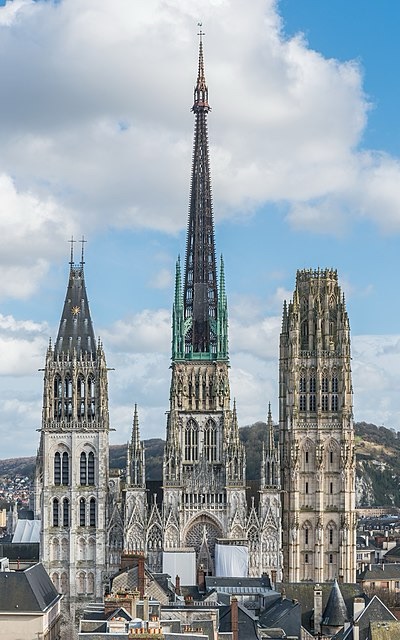
Our guide gave us a great deal of history about Rouen, Normandy, the Vikings, Joan of Arc and of course the famous Cathedral that Monet painted either 36 or 46 times (different guides, different numbers 😉).
Just a summary: the Vikings came to the area around 800 but did not settle in the area until 100 years later. Rouen was the capital of Normandy (North men) at that time. The Vikings and the Franks made a treaty to defend each other and therefore there was peace between them. William the Bastard with the help of the Normandy Vikings raided England in 1066 for the battle of Hastings. This helped William become King of England and then was called William the Conqueror.
The Cathedral was built over 5 centuries with the different parts of the church quite distinct. The oldest part is quite plain from the 10 – 11 century. The middle is from the 14th century in the flamboyant Gothic style and the final part, the Butter Tower from the 16th century, so called because the funds to build it came from a butter tax, not the pale yellow color. Unfortunately, there was a street fair directly in front of the Cathedral so we could not get a good photo.

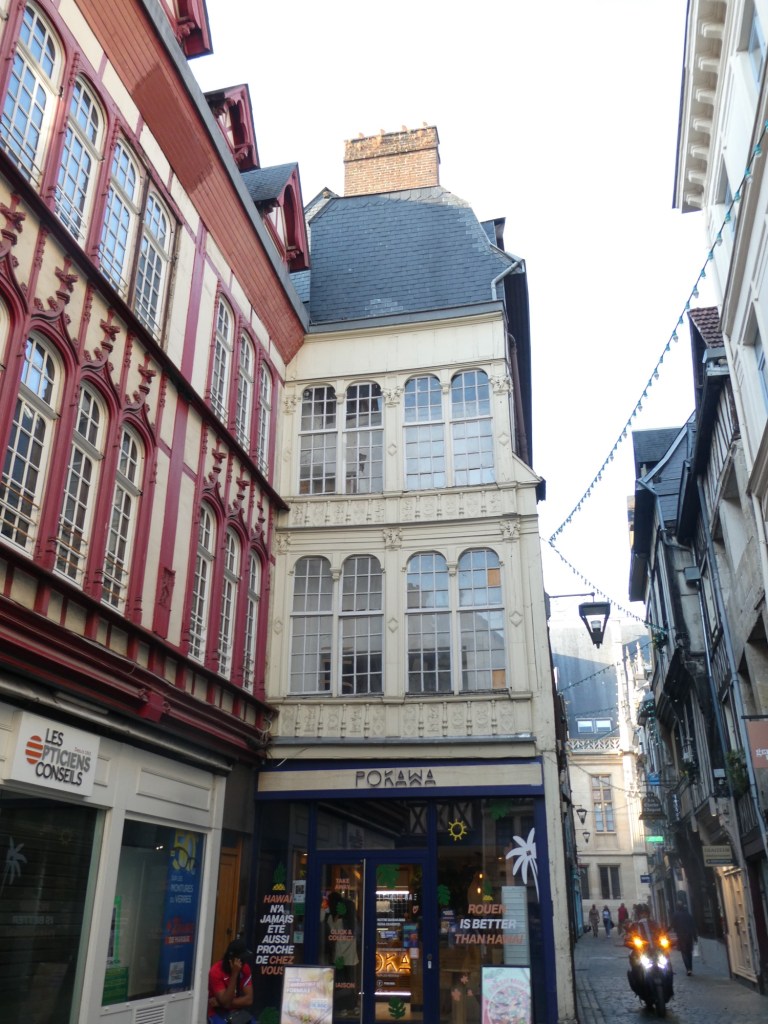
The town of Rouen is famous for its timbered houses. There are over 700 still in use. We also saw a beautiful large clock from the 14th century which is still in use and accurate. The clock besides telling the time also tells the day of the week and the phases of the moon.


We also heard the story of Joan of Arc, who as a 17 year old girl helped the French defeat the English during the 100 years war. She told the King that G-d had come to her to lead his men in battle. He agreed and she was able to win many battles. The army that she led grew as she won battle after battle. She was captured by the French, sold to the British and then was burned at the stake. She never wavered in her story and was killed probably because she was a woman who had accomplished much. She became a saint during the 19th century and is the patron saint of France. We saw the church that is dedicated to her in Rouen, supposedly near where she was killed.


 Bette and Bob See the World
You are so good as my tour guide..
LikeLike